









Due Diligence in Real Estate: Protecting High-Value Dubai Deals
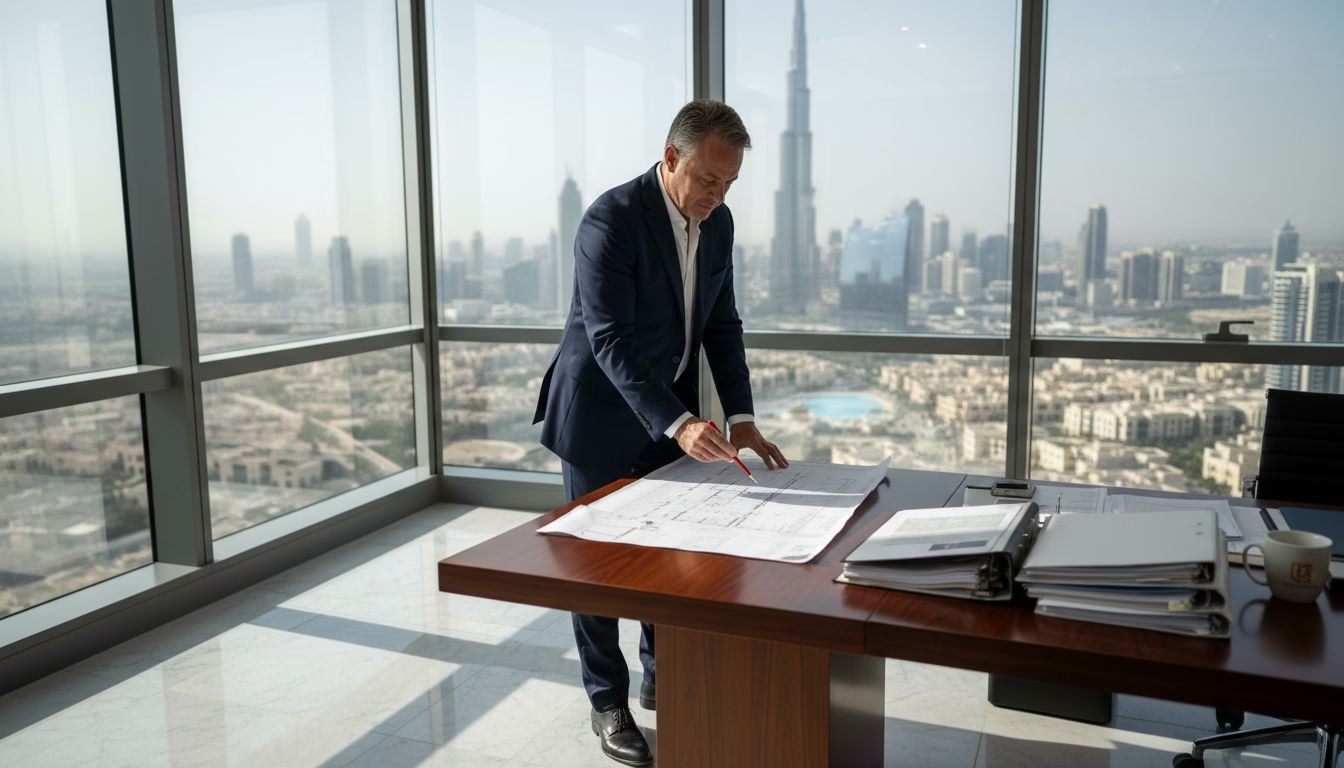
Securing property in Dubai’s luxury real estate market is more than a transaction—it’s a commitment that demands thorough investigation. High-value acquisitions often reveal complexities unseen in the United States, from unfamiliar legal frameworks to unique regulatory requirements. By mastering due diligence in real estate, American investors gain the power to uncover hidden risks and confidently protect their capital in Dubai’s dynamic environment.
Table of Contents
- What Due Diligence Means in Real Estate
- Types of Due Diligence for Luxury Properties
- Legal Framework and Process for Dubai Deals
- Critical Checks for High-Value Transactions
- Risks, Pitfalls, and How to Avoid Them
Key Takeaways
| Point | Details |
|---|---|
| Due Diligence is Essential | A thorough evaluation of the property’s physical, legal, and financial aspects helps avoid hidden issues before purchase. |
| Understanding Local Regulations is Crucial | American investors must familiarize themselves with Dubai’s unique legal framework and requirements to protect their investments. |
| Comprehensive Inspections are Necessary | Employing independent inspectors and conducting detailed assessments ensures the property meets investment standards and mitigates risks. |
| Proper Documentation and Verification | Always verify ownership and inspect all related documents to prevent potential ownership fraud and financial disputes. |
What Due Diligence Means in Real Estate
Due diligence is your systematic process of evaluating a property before you commit to a purchase. Think of it as your investment insurance—a thorough examination that uncovers what you need to know before signing.
At its core, due diligence in real estate means carefully analyzing three critical dimensions of any property: the physical condition, the legal standing, and the financial aspects. This comprehensive approach protects you from acquiring hidden problems that could tank your investment.
For American investors targeting Dubai’s luxury market, due diligence carries extra weight. You’re navigating unfamiliar legal systems, different regulatory frameworks, and international transaction complexities. What seems straightforward in Manhattan or Miami operates differently in the Emirates.
Why Due Diligence Matters for Your Investment
A property that looks pristine on the surface might have structural issues, title complications, or outstanding liens. Due diligence exposes these problems before they become your problems. It answers the questions that determine whether a deal makes sense for your portfolio.
Consider the investor who overlooked a property’s encroachment dispute in Dubai Marina. The legal battle that followed cost far more than the original purchase price. Due diligence would have caught this in days.
What Gets Examined
Your due diligence process covers these key areas:
- Physical inspection: Structural integrity, building systems, maintenance records, and current condition
- Legal verification: Title deeds, ownership history, permits, zoning compliance, and any encumbrances
- Financial analysis: Property valuation, ROI projections, rental yields, and market comparables
- Compliance assessment: Building regulations, safety standards, and Emirate-specific requirements
- Ownership verification: Confirming the seller has clear, unencumbered title and authority to sell
Due diligence also extends to understanding the broader context. You examine the developer’s track record, neighborhood trends, infrastructure plans, and market demand for the property type.
Thorough due diligence transforms a risky gamble into an informed investment decision backed by facts, not hope.
The Timeline Reality
Meaningful due diligence takes time. A proper inspection, legal review, and market analysis typically require 2-4 weeks for high-value properties. This isn’t bureaucratic delay—it’s protection.
Many American investors underestimate how much they need to learn about Dubai’s unique regulations. The Property Registration Department, the Real Estate Regulatory Authority (RERA), and developer obligations all require careful study.
Pro tip: Start your due diligence process immediately after finding a property you like, even before making a formal offer. Early discovery of deal-breakers saves you time and emotional investment in a property you ultimately can’t pursue.
Types of Due Diligence for Luxury Properties
Luxury properties demand a multi-layered inspection approach. You’re not just checking a building—you’re verifying that every aspect of a high-value asset meets your investment standards and protects your capital.
Due diligence breaks down into four interconnected categories. Each type addresses specific risks that could impact your investment, from hidden structural defects to unresolved legal claims. Understanding these categories helps you know what questions to ask and which experts you need on your team.
Here is a summary table outlining the four main types of due diligence and their unique focus areas in luxury real estate:
| Due Diligence Type | Main Purpose | Key Impact for Investors |
|---|---|---|
| Legal | Confirm ownership and legal status | Prevent title disputes and claims |
| Financial | Assess investment viability | Optimize returns and minimize costs |
| Technical | Evaluate physical and structural health | Avoid major repairs and defects |
| Environmental | Identify environmental and sustainability | Reduce exposure to hidden risks |
Legal Due Diligence
This type verifies ownership and identifies any claims against the property. You’re confirming the seller has clear title and the authority to sell what they claim to own.
Legal due diligence covers:
- Title deed authenticity and complete ownership history
- Liens, mortgages, or outstanding encumbrances
- Unpaid property taxes or municipality fines
- Easements or rights of way affecting the property
- Any disputes or pending litigation related to the property
In Dubai, this also means confirming compliance with RERA regulations and checking whether the property is registered correctly with the Property Registration Department. You cannot afford surprises here.
Financial Due Diligence
This examines the economic viability of your investment. You’re analyzing rental yields, appreciation potential, and whether the asking price reflects fair market value.
Financial analysis includes valuation against comparable properties, projected rental income, operating costs, mortgage availability, and tax implications for foreign investors. Understanding the property purchase process in Dubai helps you anticipate all costs involved.
Technical Due Diligence
Technical due diligence assessments evaluate the physical condition and structural integrity of the property. For luxury residences, this is where hidden problems emerge.
Technical inspectors examine:
- Structural soundness and foundation integrity
- Electrical, plumbing, and HVAC systems
- Safety systems and emergency protocols
- Building code compliance and permit status
- Maintenance records and deferred repairs
- Luxury finishes and specialized systems functionality
A $5 million waterfront villa might have hidden water damage or outdated electrical infrastructure that costs hundreds of thousands to repair. Technical due diligence catches these issues before closing.

Environmental Due Diligence
This evaluates environmental risks and sustainability factors. In Dubai’s desert context, this includes soil contamination history, flood risk assessments, and coastal erosion concerns for beachfront properties.
Each due diligence type protects a different aspect of your investment—ignore any one and you expose yourself to preventable risk.
Pro tip: Hire independent inspectors and legal advisors rather than relying solely on the developer or seller’s assessments; their interests conflict with yours, and their reports may downplay existing problems.
Legal Framework and Process for Dubai Deals
Dubai’s real estate system operates under a structured legal framework designed to protect investors like you. Unlike the fragmented regulations you might encounter in the United States, Dubai maintains centralized oversight through dedicated government agencies that enforce consistent standards across all transactions.
Understanding this framework is essential. The rules governing your deal differ significantly from US real estate law, and missteps can delay closing or expose you to unexpected liabilities. Your legal advisors must understand both Dubai’s system and how it differs from American property law.
The Key Government Agencies
Three entities control Dubai real estate:
- Dubai Land Department (DLD): Manages property registration, title verification, and transaction documentation
- Real Estate Regulatory Agency (RERA): Oversees developer licensing, project compliance, and dispute resolution
- Property Registration Department: Maintains the official record of all property ownership and transfers
These agencies work together to create transparency and accountability. When you buy property in Dubai, your transaction flows through each of these systems sequentially.
Registration and Legal Requirements
Every transaction requires official registration with Dubai’s regulatory framework. This isn’t optional—it’s mandatory and non-negotiable.
Key requirements include:
- Sale agreement registration: Your purchase contract must be registered with DLD within 30 days of execution
- Title transfer documentation: Complete ownership transfer requires multiple forms and proof of payment
- No-objection certificates: Confirmation that no liens, mortgages, or disputes exist against the property
- Mortgage registration: If financing the purchase, the bank’s lien must be registered with DLD
- Escrow compliance: For off-plan purchases, funds must be held in RERA-approved escrow accounts
When buying freehold versus leasehold properties, the registration process differs. Understanding whether you’re acquiring freehold or leasehold ownership affects your rights, transfer costs, and long-term ownership implications.
To help you navigate Dubai’s property purchase process, here’s a comparison table of key differences between freehold and leasehold ownership:
| Ownership Type | Transfer Process Complexity | Long-Term Rights | Typical Costs |
|---|---|---|---|
| Freehold | More straightforward | Unlimited ownership | Higher transfer fees |
| Leasehold | Additional registration steps | Fixed-term occupancy | Lower transfer fees |
The Transaction Process Timeline
A typical Dubai deal follows this sequence:
- Offer and acceptance (3-7 days)
- Preliminary agreement and deposit (1-2 days)
- Legal documentation and review (7-14 days)
- Title verification and clearance (5-10 days)
- Final payment and registration (1-3 days)
- Keys handover (1 day)
Total timeline typically runs 3-5 weeks for ready properties, longer for off-plan purchases.
Dubai’s centralized registration system protects you by creating an auditable trail of ownership and eliminating the title disputes common in other markets.
Escrow Account Requirements
For off-plan properties, RERA mandates that your money sits in an escrow account controlled jointly by the developer and bank. You cannot access these funds until construction completion milestones are met.
This protects you from developer insolvency but requires patience. Your capital remains locked until the project finishes.
Pro tip: Hire a local legal advisor registered with the Dubai Courts to navigate registration documents and coordinate with DLD; their familiarity with current regulations and procedural requirements prevents costly delays.
Critical Checks for High-Value Transactions
High-value deals demand scrutiny that goes beyond standard inspections. When you’re committing $5 million or more to a Dubai property, the cost of overlooking a single issue multiplies exponentially. This is where meticulous critical checks separate successful investors from those who regret their decisions.
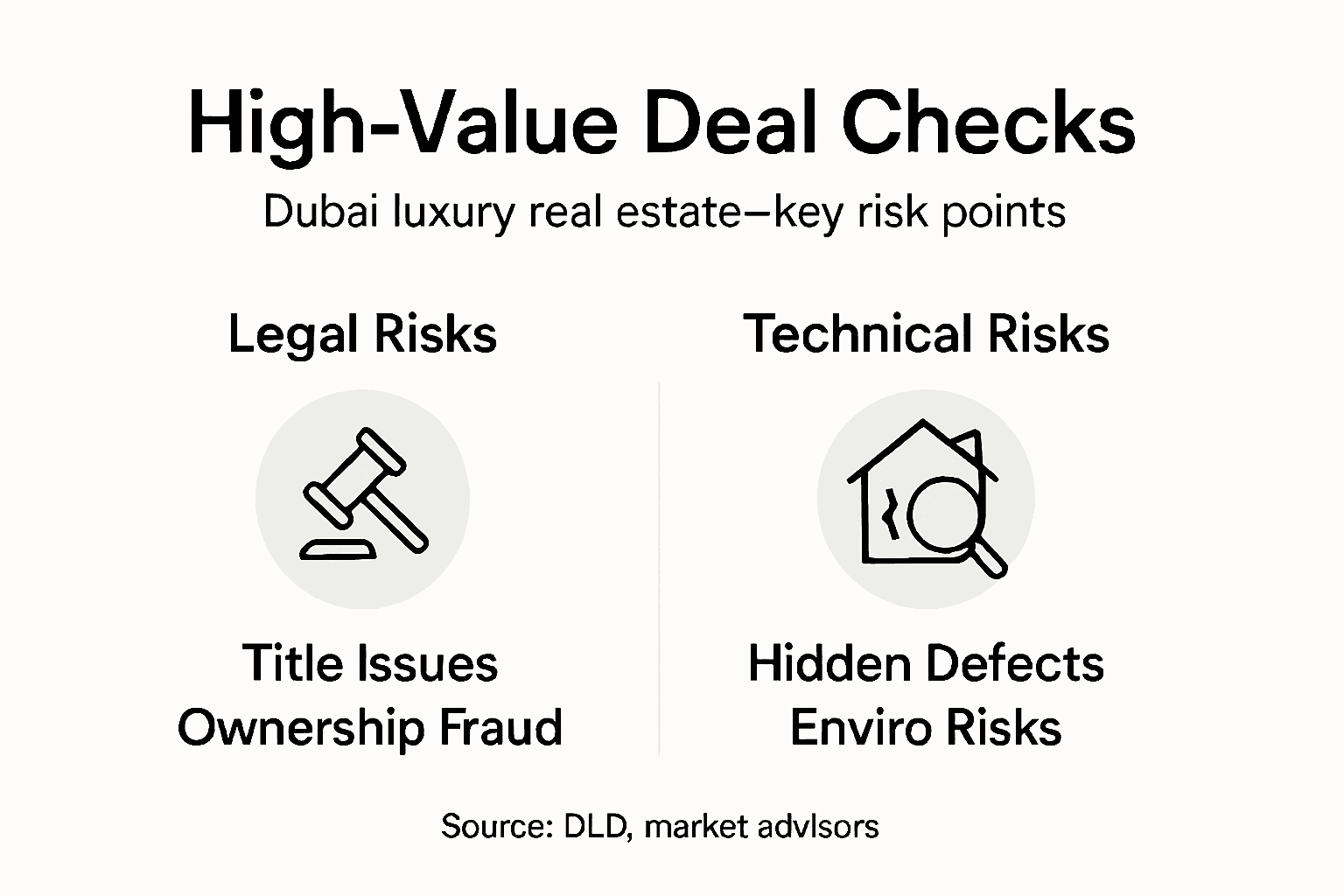
Your due diligence checklist must be exhaustive. Each item you skip represents potential financial exposure, and at this investment level, even minor oversights can cost hundreds of thousands of dollars.
Document Verification
Start by examining every document related to the property. This foundational step reveals ownership legitimacy, legal claims, and title defects.
Critical document checks include:
- Title deed originals: Verify authenticity with DLD; reject photocopies or digital scans
- Previous sale agreements: Review the last 5-10 years of transactions to understand ownership history
- Mortgage and lien documentation: Confirm all outstanding debts and their exact payoff amounts
- Property tax statements: Verify all taxes are current with no arrears or penalties
- Building permits and approvals: Confirm all construction and modifications were properly authorized
- Tenant agreements: If the property generates rental income, review all lease contracts and payment history
One investor discovered that the villa they were buying had been mortgaged three times by the seller. Only comprehensive document review uncovered this critical issue before closing.
Financial Analysis and Cash Flow
For investment properties, thorough financial assessment covers tax implications, cash flow projections, and liability verification. You need to understand exactly what this property will cost to own and operate annually.
Financial verification requires:
- Rental yield analysis: Compare projected income against property value and mortgage costs
- Operating expense breakdown: Maintenance, utilities, management fees, insurance, and property taxes
- Capital gains and exit strategy: Model scenarios for selling in 3, 5, and 10 years
- Financing options: Get pre-approval from UAE banks and understand their requirements
- Tax obligations for foreign investors: Understand UAE tax law and your US tax reporting obligations
Dubai doesn’t charge income tax on rental revenue, but your US tax obligations remain. Your accountant must confirm the tax implications before you commit.
Physical and Technical Inspection
Hire independent inspectors to conduct comprehensive building assessments. This isn’t the developer’s job—it’s yours to validate their claims.
Inspections cover:
- Structural integrity and foundation condition
- Electrical and plumbing systems functionality
- HVAC and climate control performance
- Safety systems and emergency protocols
- Luxury finishes and smart home technology
- Water intrusion and mold risk assessment
- Building code compliance verification
High-value transactions require enhanced scrutiny across regulatory compliance, environmental issues, and market risks to preserve investment value.
Title and Ownership Clearance
Obtain a no-objection certificate from DLD confirming no liens, mortgages, or disputes exist. This document is non-negotiable for high-value purchases.
Verify that the seller holds clear, unencumbered title and has the legal authority to sell the property. Any ambiguity here should be a deal-breaker.
Environmental and Market Risk Assessment
For beachfront or desert properties, assess environmental risks including flood zones, soil contamination, and coastal erosion. Market analysis includes comparing your purchase price against recent sales of comparable properties.
Pro tip: Assemble your due diligence team before making an offer: hire a legal advisor, inspector, accountant, and real estate analyst; their coordinated input ensures you catch problems that isolated reviews would miss.
Risks, Pitfalls, and How to Avoid Them
Dubai’s real estate market attracts legitimate investors and opportunists alike. Understanding the specific risks you face—and how to mitigate them—separates informed buyers from those who discover problems too late.
The stakes are too high to approach this casually. At the $5 million level, a single oversight can cost you hundreds of thousands of dollars or trigger legal entanglements that drain years of your attention.
Title and Ownership Fraud
Counterfeit title deeds exist. Sellers can misrepresent ownership, forge documents, or claim authority they don’t possess. This risk sounds extreme until you encounter it.
To avoid ownership fraud:
- Verify directly with DLD: Never rely on documents alone; contact the Property Registration Department to confirm ownership
- Request original title deeds: Reject any seller who cannot produce originals or provides only scans
- Cross-reference property records: Ensure the property listed in documents matches the physical property
- Investigate ownership history: Trace the previous 10 years of transactions to identify unusual patterns
- Confirm seller identity: Verify the seller’s identity documents match the title deed exactly
One investor lost $2 million on a villa because the seller’s brother provided the title deed—without power of attorney. The legal battle to recover funds lasted four years.
Money Laundering and Beneficial Ownership Risks
Dubai’s position as a global hub creates exposure to illicit transactions. Risk-based due diligence measures require verifying beneficial ownership and understanding transaction backgrounds to ensure integrity.
Understand who actually owns the property:
- Identify beneficial owners: Require documentation showing the ultimate beneficial owner, not just the registered entity
- Request source of funds verification: Know where the seller’s money came from
- Review transaction history: Multiple quick sales at inflated prices signal potential money laundering
- Check for sanctions violations: Verify neither the seller nor beneficial owners appear on international sanctions lists
Accepting a property with unclear beneficial ownership exposes you to regulatory scrutiny and potential asset seizure.
Construction and Design Defects
High-value transactions face amplified risks from design and construction disputes. Luxury finishes hide structural problems that reveal themselves years later.
Risk mitigation requires:
- Detailed technical inspections: Hire certified inspectors to identify defects before closing
- Evaluate contractor quality: Verify the developer’s track record and past performance
- Document all changes: If modifications were made post-completion, verify proper approvals
- Confirm insurance coverage: Ensure adequate structural warranty and defect insurance exists
A $6 million penthouse had foundation cracks hidden behind custom wall treatments. Technical inspection caught the problem; the developer was forced to remediate before sale.
Financing and Liquidity Risks
UAE banks require 20-30 percent down payments and impose strict lending requirements. Some investors underestimate how challenging it is to finance luxury properties or exit positions quickly.
Minimize financing risk:
- Secure pre-approval before making offers: Confirm financing is actually available
- Understand market liquidity: Recognize that ultra-luxury properties can take 6-12 months to sell
- Build cash reserves: Plan for unexpected repairs, vacancies, or market downturns
Due diligence protects you by identifying risks before they become your responsibility.
Contractual and Dispute Resolution Issues
Dubai contracts differ from American agreements. Ambiguous terms or missing contingencies create disputes that end in arbitration—an expensive and time-consuming process.
Ensure your legal advisor reviews all contracts carefully. Define scope precisely, specify remedies for breaches, and confirm you have recourse if problems arise.
Pro tip: Retain insurance coverage for title defects, construction defects, and professional liability; this protects you against risks that due diligence cannot completely eliminate.
Secure Your High-Value Dubai Investment with Expert Guidance
Investing in luxury properties in Dubai requires more than just passion and capital. The challenges of due diligence such as verifying legal ownership, evaluating financial viability, and conducting thorough technical inspections demand specialized knowledge and trusted partners. Avoid costly pitfalls like title disputes or hidden structural defects by leveraging professional insights tailored for high-value deals.
Explore our comprehensive services at https://ابتكارللمعلومات.com where you will find expert advice on the property purchase process in Dubai and insights into freehold vs leasehold properties. Start protecting your investment now with trusted market analysis and listings for exclusive luxury homes in prestigious locations such as Dubai Marina and Emirates Hills. Visit our platform to turn complex due diligence into confident decisions.
Frequently Asked Questions
What is due diligence in real estate?
Due diligence in real estate is the systematic process of evaluating a property before purchase. It includes analyzing the physical condition, legal standing, and financial aspects of a property to uncover hidden problems and protect your investment.
Why is due diligence important for high-value properties?
Due diligence is crucial for high-value properties because it helps identify critical issues that could impact your investment, such as structural defects, legal complications, or financial inconsistencies. This thorough examination decreases the risk of costly surprises after the purchase.
What are the main types of due diligence involved in real estate transactions?
The main types of due diligence in real estate transactions include legal due diligence (verifying ownership and claims), financial due diligence (assessing investment viability), technical due diligence (evaluating physical condition), and environmental due diligence (identifying potential environmental risks).
How long does the due diligence process typically take?
The due diligence process generally takes 2-4 weeks for high-value properties. This timeframe allows for thorough inspections, legal reviews, and market analyses to ensure a comprehensive assessment of the property.
Recommended
- Overview of the Property Purchase Process in Dubai
- How to Choose Luxury Property Within Your Budget: Expert Tips for Real Estate Investment
- Best Real Estate Agent in Dubai: How to Find the Right One
- Real Estate in Dubai: Complete Investment Guide
- Role of Real Estate Agents: Unlocking Investor Advantage | Elite Wealth Creators